Court Marriage in Pakistan – A Complete Guide
Court marriage in Pakistan has emerged as a significant legal and social phenomenon, offering couples a streamlined, legally protected alternative to traditional matrimonial arrangements. As Pakistani society evolves—balancing tradition, religious norms, and modern legal reforms—court marriage stands at the intersection of personal autonomy, constitutional rights, and cultural expectations. This comprehensive article explores the legal framework, eligibility criteria, required documentation, step-by-step procedures, roles of officials, rights and protections, social context, common misconceptions, and province-specific variations. Drawing on recent legislative updates, expert legal commentary, and real-world case studies, the report aims to provide an exhaustive guide for couples, legal professionals, and policymakers.
Legal Framework Governing Court Marriage in Pakistan
Constitutional and Statutory Foundations
Court marriage in Pakistan is firmly anchored in the country’s legal system. The Constitution of Pakistan guarantees every adult citizen the right to marry by free will, irrespective of familial, ethnic, or religious pressures. This constitutional right is operationalized through several key statutes:
- Muslim Family Laws Ordinance, 1961: This ordinance modernized marriage registration, polygamy regulations, maintenance, divorce, and inheritance for Muslims. It mandates the registration of all marriages and provides a legal framework for spousal rights, including maintenance and dower.
- Family Courts Act, 1964: Establishes specialized family courts for the expeditious settlement of disputes related to marriage, divorce, maintenance, custody, and related issues. Family courts have exclusive jurisdiction over family matters, including the registration and protection of court marriages.
- Child Marriage Restraint Act, 1929 (and Amendments): Sets the minimum legal age for marriage. Recent amendments and the Child Marriage Restraint Bill, 2025, have standardized the minimum age at 18 for both males and females nationwide, with strict penalties for violations.
- Marriage Act, 1872 (for non-Muslims): Governs marriages for Christian and Hindu citizens, with similar requirements for registration and legal recognition.
These laws collectively ensure that court marriages are not only religiously valid (for Muslims, through the Nikah contract) but also legally recognized by the state, providing couples with robust protections and rights.
Recent Legislative Developments
The passage of the Child Marriage Restraint Bill, 2025 marks a watershed moment in Pakistan’s legal landscape. Signed into law by President Asif Ali Zardari, the bill fixes the minimum legal age for marriage at 18 for both genders, criminalizes child marriage, and empowers courts to intervene proactively. Violators—including Nikah Khawans who solemnize underage marriages—face imprisonment and hefty fines. The law also provides for whistleblower protection and confidentiality in reporting violations.
Sindh and Balochistan have enacted similar legislation, and the federal government is urging other provinces to harmonize their laws. Despite opposition from some religious quarters, these reforms align Pakistan with international standards on child rights and protection.
Legal Recognition and Registration
Court marriages are recognized under Pakistani law once registered with the relevant local authority—typically the Union Council, Cantonment Board, or NADRA (National Database and Registration Authority). The issuance of a computerized marriage certificate (Nikah Nama) is essential for legal recognition, inheritance claims, and administrative purposes.
Eligibility Criteria and Legal Age Requirements
Age and Mental Capacity
The minimum legal age for marriage in Pakistan is now 18 years for both males and females, following the Child Marriage Restraint Bill, 2025. Previously, some provinces allowed marriage at 16 for females, but recent reforms have standardized the age nationwide. Marriages involving minors are strictly prohibited and can result in criminal prosecution.
Both parties must possess the mental capacity to understand the implications of marriage. This means they should not be suffering from any mental disabilities that would impair their ability to make informed decisions.
Marital Status and Consent
- Single Status: Both individuals must be single, divorced, or widowed at the time of marriage. Proof of dissolution of any prior marriage (divorce decree or death certificate) is required.
- Free Will and Consent: Voluntary consent is a cornerstone of legal marriage in Pakistan. Both parties must provide unequivocal consent, free from coercion or deception. The bride, in particular, must submit a free-will affidavit attested by a judicial officer or notary public.
Religious and Caste Considerations
For Muslims, the Nikah contract must comply with Islamic principles. A Muslim man may marry a Christian or Jewish woman without requiring her to convert, but a Muslim woman marrying a non-Muslim man may face additional religious requirements. Interfaith and intercaste marriages are legally permitted, though couples may encounter social challenges.
Province-Specific Rules
- Sindh: Minimum age is 18 for both genders, with strict enforcement and penalties for child marriage.
- Punjab: Previously allowed marriage at 16 for females, but recent reforms are moving toward 18 as the standard.
- KPK and Balochistan: Implementation varies, but federal law now prevails.
Required Documents for Court Marriage
The documentation required for court marriage varies slightly depending on whether both parties are Pakistani nationals or if one is a foreign national. The following tables summarize the requirements:
Table 1: Required Documents for Pakistani Nationals
Document | Groom | Bride | Notes |
CNIC (Computerized National ID) | Yes | Yes | Essential for age and identity verification |
Passport Size Photos | Yes | Yes | Typically 4–6 recent photos each |
Free Will Affidavit | No | Yes | Bride must affirm voluntary consent |
Divorce/Death Certificate | If applicable | If applicable | For previously married individuals |
Witnesses’ CNICs | Yes | Yes | Two adult witnesses required |
Domicile/Proof of Address | Yes | Yes | Sometimes required for registration |
Explanation: Both parties must present valid CNICs or equivalent identification (B-Form, passport, or educational certificate if CNIC is unavailable). The bride’s free-will affidavit is crucial, especially in cases of family opposition. Witnesses must also provide identification. Divorce or death certificates are mandatory if either party was previously married.
Table 2: Required Documents for Foreign Nationals
Document | Groom | Bride | Notes |
Passport (with valid visa) | Yes | Yes | Essential for foreign nationals |
CNIC/NICOP (Pakistani partner) | Yes | Yes | Pakistani partner must have CNIC/NICOP |
No Objection Certificate (NOC) | Yes | Yes | From foreigner’s embassy |
Proof of Residence | Yes | Yes | Address verification |
Divorce/Death Certificate | If applicable | If applicable | For previously married individuals |
Witnesses’ CNICs | Yes | Yes | Two adult witnesses required |
Explanation: Foreign nationals must provide a valid passport, visa, and NOC from their embassy. The Pakistani partner must have a CNIC or NICOP. All documents should be translated and attested if not in Urdu or English. Witnesses are required as in standard procedure.
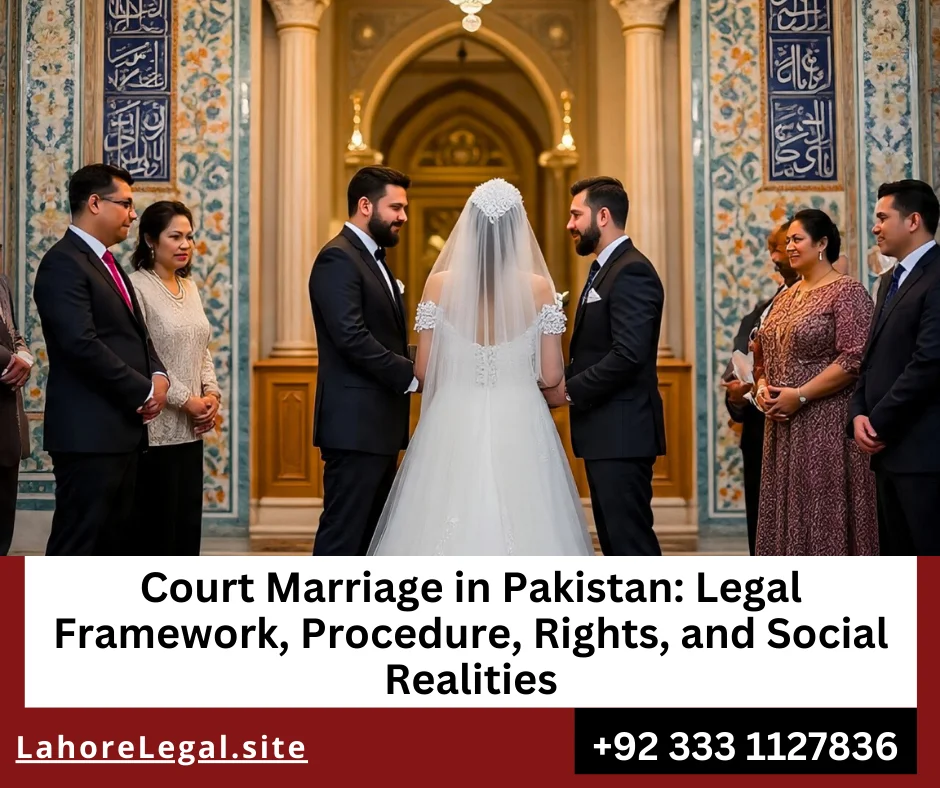
Step-by-Step Court Marriage Procedure
The court marriage process in Pakistan is designed to be straightforward, efficient, and legally robust. The following steps outline the typical procedure:
1. Preparation of Documents
Couples must gather all required documents, including identification, photographs, affidavits, and proof of dissolution of any prior marriage. Legal experts recommend preparing these documents in advance to avoid delays.
2. Witness Arrangement
Two adult male witnesses (or one male and two females) are required to be present at the time of marriage. Witnesses must provide valid identification. If couples cannot arrange witnesses, professional legal services can provide them.
3. Legal Consultation and Affidavit Drafting
Hiring an experienced court marriage lawyer is strongly advised. The lawyer verifies documents, drafts affidavits (especially the bride’s free-will affidavit), and ensures compliance with legal formalities. The lawyer also provides guidance on rights, protections, and privacy.
4. Nikah Ceremony
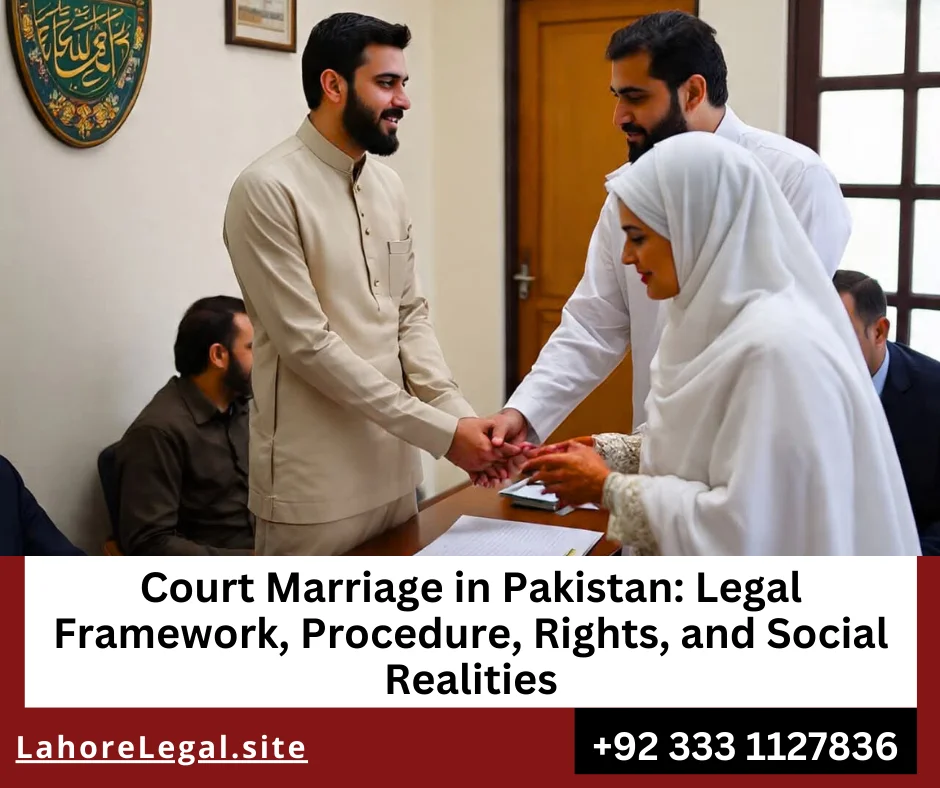
A licensed Nikah Registrar or Nikah Khawan (Qazi/Imam) performs the Nikah in the presence of the couple and witnesses. The ceremony includes the recitation of Quranic verses, the ijab-o-qabool (offer and acceptance), and the documentation of Haq Mehr (dower).
5. Registration of Nikah Nama
The Nikah Nama (marriage contract) is filled out and signed by the bride, groom, witnesses, and Nikah Khawan. The document records essential details, including personal information, dower amount, maintenance terms, and divorce rights.
6. Submission to Union Council
The Nikah Nama, along with supporting documents, is submitted to the local Union Council or relevant authority (Cantonment Board, TMA office, Arbitration Council). The Union Council verifies the documents and registers the marriage.
7. Issuance of NADRA Marriage Certificate
Upon successful registration, the Union Council issues a computerized marriage certificate (NADRA Marriage Registration Certificate). This certificate is essential for legal recognition, inheritance claims, visa applications, and administrative purposes.
8. Optional: Court Protection Orders
If couples face threats or harassment from family or community, they can apply for protection with the Session Court or High Court. The court may issue protection orders, direct police to provide security, and restrain respondents from interfering in the couple’s lawful life.
Table 3: Typical Timeline and Fees for Court Marriage
City | Estimated Fee (PKR) | Typical Timeline |
Islamabad | 25,000 – 50,000 | 1–2 hours (ceremony); 3–10 days (certificate) |
Lahore | 20,000 – 45,000 | 1–2 hours; 3–10 days |
Karachi | 25,000 – 50,000 | 1–2 hours; 3–10 days |
Rawalpindi | 20,000 – 40,000 | 1–2 hours; 3–10 days |
Smaller Cities | 10,000 – 25,000 | 1–2 hours; 3–10 days |
Explanation: Fees vary by city, legal complexity, and services required. The process can be completed within a few hours if all documents are available. Registration and issuance of the NADRA certificate may take up to 10 days.
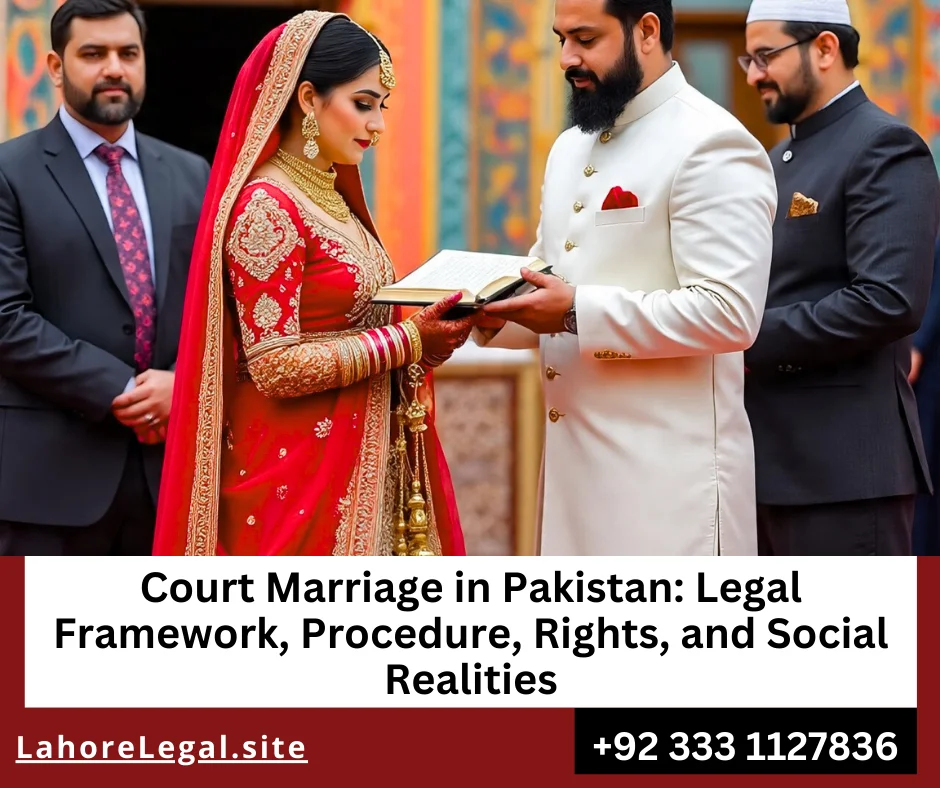

Roles and Duties of Officials
Nikah Registrar / Nikah Khawan
The Nikah Registrar is a government-authorized official responsible for solemnizing marriages and registering them according to Pakistani law. Their duties include:
- Performing the Nikah ceremony in accordance with Islamic principles.
- Ensuring both parties have given free consent.
- Filling out and registering the Nikah Nama with the local authority.
- Submitting the Nikah Nama for legal registration and issuance of the marriage certificate.
- Advising couples on their rights and obligations under the law.
A certified Nikah Khawan ensures the ceremony is conducted legitimately, respecting both religious and legal requirements. Their expertise is crucial for the validity and documentation of the marriage.
Family Court, Magistrate, and Union Council
- Family Court: Handles disputes related to marriage, divorce, maintenance, custody, and related issues. Family courts can issue protection orders and attempt reconciliation before proceeding to trial.
- Magistrate: May be involved in attesting the marriage, especially if legal protection is sought. Couples may record statements under Section 164 CrPC before the magistrate to affirm free will and consent.
- Union Council: Responsible for registering marriages, maintaining official civil records, and issuing the NADRA marriage certificate. The Union Council preserves copies of the Nikah Nama and supporting documents for legal and administrative purposes.
NADRA (National Database and Registration Authority)
NADRA issues computerized marriage certificates based on the verified Nikah Nama and supporting documents. The certificate is essential for legal recognition, administrative tasks, and international use.
Rights and Protections After Court Marriage
Spousal Rights Under Pakistani Law
The Muslim Family Laws Ordinance and related statutes guarantee a range of rights and protections for spouses:
- Right to Dower (Haq Mehr): The wife’s absolute property, gifted by the husband during Nikah. She may claim prompt dower immediately and deferred dower at any time.
- Right to Maintenance: The husband is obligated to provide financial support for the wife and minor children. Maintenance is enforceable by law, and the Supreme Court has ruled that the wife is entitled to maintenance immediately after marriage, regardless of consummation.
- Right to Protection: Both spouses can seek protection against domestic violence, threats, or harassment through family courts or women’s protection centers.
- Right to Divorce: Women have the right to seek divorce (khula) and men can initiate talaq. Both have the right to dissolve the marriage through legal procedures.
- Right to Inheritance: A registered court marriage establishes inheritance rights. The surviving spouse is entitled to a share of the deceased’s estate as per Islamic law or relevant statutes. Children from a court marriage are legitimate heirs.
- Right to Child Custody: Both spouses can seek custody of children after dissolution of marriage. Courts prioritize the welfare of the child.
- Right to Respect and Dignity: Both partners are obligated to treat each other with mutual respect, and legal remedies exist for violations.
Protection Orders and Remedies
Couples facing threats, harassment, or honor-based violence can seek protection orders from the Session Court or High Court. The court may direct police to provide security, restrain respondents from interference, and ensure the couple’s safety. Legal aid organizations and NGOs offer support, counseling, and safe housing.
Table 4: Legal Protections and Remedies
Threat/Issue | Legal Remedy/Protection | Authority/Support |
Family opposition | Protection order, police security | Session Court, NGOs |
Honor threats | Court protection, safe housing | High Court, NGOs |
Domestic violence | Family court intervention | Family Court, Women’s Centers |
Forced marriage | Nullification, criminal prosecution | Family Court, Police |
Inheritance disputes | Legal claim, certified marriage certificate | Civil Court, NADRA |
Explanation: Legal remedies are available for a range of threats and challenges. Courts, police, and NGOs collaborate to protect couples’ rights and safety.
Common Legal Challenges and Grounds for Annulment
Legal Challenges
- Objections to Marriage: Disputes over eligibility, consent, or documentation can lead to legal challenges. Courts verify documents, consent, and marital status before approving the union.
- Annulment: Grounds for annulment include lack of free consent, underage marriage, fraud, or existing marital obligations. Marriages not conducted according to legal procedures are considered invalid and can result in denial of rights, property disputes, and custody issues.
- Fake Documentation: Submission of fraudulent documents can lead to annulment and legal penalties. Verification by legal experts is essential.
- Interfaith and Intercaste Marriages: While legally permitted, such unions may face additional scrutiny and social challenges. Legal compliance is crucial for recognition.
Grounds for Challenge
- Underage marriage (below 18 years)
- Lack of free will or consent
- Fraudulent documentation
- Existing valid marriage
- Prohibited degrees of relationship
Costs, Fees, and Typical Timelines
Court marriage is generally more cost-effective than traditional weddings. Fees vary by city, legal complexity, and services required.
Table 5: Court Marriage Fees in Major Cities (2025)
City | Estimated Fee (PKR) | Notes |
Islamabad | 25,000 – 50,000 | Includes documentation, registration, legal consultation |
Lahore | 20,000 – 45,000 | Similar structure; may vary by firm |
Karachi | 25,000 – 50,000 | Higher fees for urgent or complex cases |
Rawalpindi | 20,000 – 40,000 | Lower end for basic services |
Smaller Cities | 10,000 – 25,000 | Fewer administrative costs |
Explanation: Fees cover legal consultation, affidavit preparation, Nikah registration, witness arrangement, and certificate issuance. Additional costs may apply for urgent processing, translation, or protection orders.
Typical Timeline
- Nikah Ceremony: 15–30 minutes if all documents are available.
- Registration: 1–2 hours for submission; 3–10 days for NADRA certificate.
- Protection Orders: May take longer depending on court schedule.

Cultural and Social Context of Court Marriages
Societal Perceptions and Challenges
Court marriage in Pakistan is often viewed through the lens of tradition, family honor, and religious norms. While legally valid and increasingly accepted in urban centers, couples opting for court marriage may face:
- Family Opposition: Many families view court marriage as bypassing parental authority and customary rituals. This can lead to estrangement, social alienation, or even honor-based violence.
- Honor Threats: In conservative regions, couples may face threats to their safety, including honor killings. Legal protection and support from NGOs are essential in such cases.
- Social Stigma: Court marriages may be stigmatized as lacking religious sanctity or social acceptance. However, legal and religious authorities affirm their validity if conducted according to Islamic principles.
- Media Influence: Portrayal of court marriages in media and popular culture has helped demystify the process, making it more acceptable among younger generations.
Case Studies and Trends
- Urban Centers: Karachi, Lahore, Islamabad, and Rawalpindi have seen a significant rise in court marriages, reflecting a shift toward personal autonomy and legal recognition over traditional norms.
- Rural Areas: Traditional arranged marriages remain predominant, and court marriages may face greater resistance and risk.
- Honor-Based Violence: High-profile cases (e.g., Qandeel Baloch, Saba Qaiser) highlight the risks faced by women exercising autonomy in marriage decisions. Legal reforms and awareness campaigns are crucial for protection.
Support Organizations and NGOs
Several organizations provide legal aid, counseling, and protection for couples facing challenges:
- Legal Aid Society (LAS): Offers free legal advice, protection services, and community outreach, especially in Sindh.
- Centre for Human Rights (CFHR): Conducts workshops, legal clinics, and advocacy campaigns to empower women and protect marriage rights.
- Women’s Protection Centers: Provide shelter, counseling, and legal support for victims of domestic violence or honor threats.
Role of Lawyers and Legal Services
Hiring a qualified court marriage lawyer is highly recommended. Lawyers:
- Verify documents and eligibility.
- Draft affidavits and legal paperwork.
- Arrange witnesses and represent couples in case of legal hurdles.
- Ensure privacy, confidentiality, and legal protection.
- Facilitate registration and issuance of certificates.
- Provide post-marriage legal support, including protection orders and administrative formalities.
Differences Between Nikah and Court Marriage
Religious vs. Civil Aspects
- Nikah: The Islamic marriage contract, performed by an Imam or Nikah Khawan, requires offer and acceptance, witnesses, and agreement on Mehr. Nikah may be performed at home, mosque, or banquet hall, but legal proof requires registration.
- Court Marriage: The legal process of performing and registering the Nikah in the presence of a government-licensed Nikah Registrar, often at the Union Council or Family Court. Registration is immediate, and the marriage certificate is issued on the spot.
Both are Islamically valid if conditions are met, but only registered marriages are recognized by the state for official purposes.
Post-Marriage Formalities
After court marriage, couples may need to complete additional administrative tasks:
- Name Change: Women often update their names on CNIC, passport, and other documents. The process involves submitting a legal affidavit, marriage certificate, and supporting documents to NADRA and other authorities.
- Joint Bank Accounts: Couples can open joint accounts by presenting the marriage certificate and updated identification.
- Passports and Visas: The NADRA marriage certificate is required for spousal visa applications, immigration, and international travel.
- Family Registration Certificate (FRC): Couples may obtain an FRC from NADRA for administrative purposes.
Province-Specific Rules and Variations
- Sindh: Minimum age is 18 for both genders; strict enforcement of child marriage laws; robust legal protections.
- Punjab: Moving toward 18 as the standard minimum age; implementation varies; ongoing legislative reforms.
- KPK and Balochistan: Implementation varies; federal law now prevails; Balochistan has passed the Child Marriage Prohibition Bill, 2025.
- Islamabad Capital Territory: Governed by federal law; minimum age is 18.
Common Misconceptions About Court Marriage
Table 6: Common Misconceptions and Facts
Misconception | Fact |
Court marriage is illegal | Court marriage is 100% legal and protected by law |
Only couples without family approval opt for court marriage | Couples with mutual family support also choose court marriage for privacy and simplicity |
Court marriage lacks religious sanctity | A valid Nikah is performed, meeting both legal and religious requirements |
Parental consent is required | Not required if both parties are adults and give free consent |
Court marriage is not recognized internationally | Registered court marriages are recognized abroad, provided the documentation is complete |
Court marriage is lengthy and complex | The process is efficient and can be completed within hours if the documents are ready |
Explanation: Dispelling myths is crucial for informed decision-making. Legal and religious authorities affirm the validity and protections of court marriage.
Support Organizations, Helplines, and NGOs
- Legal Aid Society (LAS): Toll-free legal helpline (0800-70806), legal clinics, outreach, and protection services.
- Centre for Human Rights (CFHR): Workshops, legal clinics, advocacy campaigns, and strategic litigation for women’s marriage rights.
- Women’s Protection Centers: Shelter, counselling, and legal support.
- Online Legal Services: Many law firms offer online consultations, document preparation, and urgent support via WhatsApp and other platforms.
Conclusion
Court marriage in Pakistan represents a legally protected, efficient, and increasingly accepted method for couples to solemnize their union. Anchored in constitutional rights and robust statutory frameworks, court marriage empowers individuals to exercise autonomy, bypassing traditional barriers and familial opposition. The process is straightforward, cost-effective, and ensures comprehensive legal recognition and protection.
Despite its advantages, court marriage is not without challenges. Couples may face social stigma, family opposition, and threats to safety, especially in conservative regions. Legal reforms, awareness campaigns, and support from NGOs are essential to safeguard rights and promote acceptance.
As Pakistan continues to harmonize its marriage laws, raise the minimum age, and strengthen protections, court marriage stands as a testament to the country’s commitment to individual rights, gender equality, and social progress. Couples considering court marriage are advised to seek professional legal guidance, prepare thorough documentation, and remain informed about their rights and remedies.
Key Takeaway: Court marriage in Pakistan is a legitimate, secure, and pragmatic choice for couples seeking legal recognition, privacy, and protection. With proper legal support and awareness, couples can navigate the process confidently, ensuring their union is both religiously and legally valid.
Appendix: Quick Reference Tables
Table 7: Court Marriage Checklist
Step | Action Required |
Document Preparation | CNICs, photos, affidavits, certificates |
Witness Arrangement | Two adult witnesses with CNICs |
Legal Consultation | Hire a qualified lawyer |
Nikah Ceremony | Performed by licensed Nikah Registrar |
Registration | Submit Nikah Nama to Union Council |
NADRA Certificate | Obtain computerized marriage certificate |
Protection Orders (if needed) | Apply to Session Court/High Court |
Post-Marriage Formalities | Name change, joint accounts, passports |
Table 8: Support Resources
Organization | Services Provided | Contact/Helpline |
Legal Aid Society (LAS) | Legal advice, protection, outreach | 0800-70806 |
Centre for Human Rights (CFHR) | Workshops, clinics, advocacy | Online query/WhatsApp |
Women’s Protection Centers | Shelter, counseling, legal support | Local centers |
Online Legal Services | Consultation, document preparation | WhatsApp, online platforms |
For further guidance, couples are encouraged to consult our reputable legal professionals to ensure a smooth, confidential, and legally sound court marriage experience in Pakistan.